Nick Enea

Dutch, 1606-1684
A Richly Laid Table with Parrots – 1655
Collection of the John and Mable Ringling Museum of Art, Florida
Jan Davidsz de Heem (1606-1684) was known as a still-life Baroque painter, mostly painting on an oil canvas, born in Utrecht (Netherlands). Still-life, as seen in the above painting, often portrays realistic inanimate objects. Heem was able to combine his realistic techniques with Baroque painting, which utilizes intense shadows using light and dark colors, with rich color saturation. In 1635, Heem entered the Guild of Saint Luke, an assemblage of lucrative artists, where he continued to practice his art. He spent time living in Utrecht and Antwerp (Belgium) throughout his life, but ended up residing in Antwerp in 1672 until his death in 1684. A Richly Laid Table with Parrots is an oil-on-canvas created in 1655, during the Dutch Golden Age (late 16th – late 17th century). Due to Heem’s incredibly realistic still life techniques, he likely went with an oddly specific and realistic title for his painting, rather than taking a more symbolic approach. A perfect world is one in which no one has to worry about the amount of food they have, and Heem’s still life realism reflects how realistic and probable this is in a Utopia. The large piles of food demonstrate an ideal society where everyone has plenty of healthy foods in their house and never has to worry about it running out. There is a plethora of grapes overflowing off the edge of the table, and there is no need for someone to get rid of the parrot due to the amount of food. Heem implements intense shading in the background and underneath the table to order to strengthen the contrast between the vibrant red and green food on the table. This draws attention directly to the mountains of food on the table, rather than what is going on in the background.

American, 1972-present
We Got Your Back – unknown
Collection of The Walking Gallery of Healthcare, Maryland
Regina Holliday (1972-present) is a strong advocate for easy access to medical records. She was born in Oklahoma and currently resides in Grantsville, Maryland as an art teacher, muralist, and contemporary painter. In 2009, Holliday’s husband, Fred, was diagnosed with kidney cancer. He died an unnecessarily convoluted death due to the implications of gaining access to his medical records. After Regina was forced to switch hospitals in order to get Fred’s records, medical professionals were left in the unknown about Fred’s medical history, and Fred was unable to answer the questions himself. From that moment, Regina dedicated her life for people to have better access to medical records. She founded The Walking Gallery of Healthcare, where a patient’s story is painted on the back of a jacket for them to wear as they walk around. We Got Your Back was painted on the back of a jacket and is a part of the Walking Gallery in order to share a patient’s healthcare story, but the date it was painted is unknown. The painting includes seven individuals standing in a line alongside a cliff, and Holliday implements a great use of contrast in her vibrant green, grassy cliff, and the dark waves of the ocean. Off in the distance, there is a book floating in the sky, which one can assume is a book of medical records, as Holliday advocates for gaining access to medical records. The title We Got Your Back literally portrays the backside of seven individuals, but it also symbolizes the idea of universal healthcare for all people, regardless of age, race, or gender. Healthcare is so different across the world, each receiving its own version of criticism, but an ideal society would provide universal healthcare so everyone can be healthy and not have to worry about expenses.
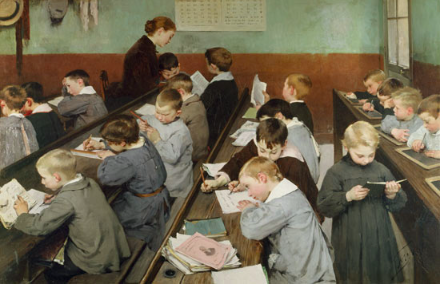
French, 1853-1924
The Children’s Class – 1889
Collection of the Ministere de l’Education Nationale, Paris
Jean Geoffroy (1853-1924) was known as an oil on canvas painter that spent most of his time painting large groups of children. He was born in Marennes (France) and continued to live his life there until death. At 14 years old, Geoffroy joined the municipal school of design and sculpture where they taught men to develop their skills in all different areas of art (carving, sculpting, drawing, painting). In the hopes to pursue more formal training, Geoffroy signed up for courses at the Ecole des Beaux-Arts to become a professional fine arts painter. His art education was temporarily postponed due to the start of the Franco-Prussian War in 1870 (ended in 1871). Art galleries were in a time of chaos due to the lack of produced art during the war, which motivated Geoffroy to create more art. As the war came to an end, Geoffroy got a job as an illustrator for children’s literature. He liked painting images of children under the French flag to demonstrate France’s commitment to education for all people, which is why this image reflects what an ideal society would look like. The Children’s Class (1889) is an oil on canvas painting that portrays many boys and girls working hard in school, with their teacher walking around the classroom answering their questions. This reflects a Utopian society where every individual has access to a quality education. Geoffroy implements monotonous-colored clothing to show how no one stands above another student; everyone is given the same opportunities and the same treatment of respect by the teacher and their peers.
