Elyssa Fischer
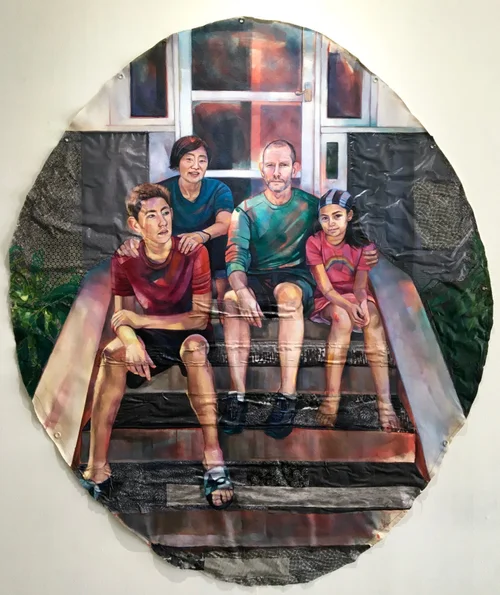
American, 1989-present
Sami, Tari, Mayson, and Oliver – 2017
Collection of Leslie Barlow
Minneapolis born and based Leslie Barlow created “Sami, Tari, Mayson, and Oliver” in 2017 as a part of her collection, Loving, which explores interracial relationships and is named after the pivotal Loving v. Virginia case that officially legalized interracial marriage in 1967. Barlow mainly creates oil paintings, and this piece additionally utilizes pastels, acrylics, and collaged sewn fabrics on canvas, a symbol of the patchwork-like and unique qualities that make up a multi-racial identity. Born in 1989 to a Black father and white mother, Barlow constantly struggled with her racial identity. The election of and racial discourse surrounding Donald Trump in 2016 greatly affected Barlow, who creates contemporary art that portrays activist messages. The relatively plain background and poses of the family work to demonstrate the quiet and simple beauty and intimacy between the family. Bright pastel colors emphasize the family members and the open screen door of the house, a nod to the most important part of the work and of the story– the people and the home they create. Within the utopia, there is diversity of races and families and this diversity leads to happiness and fulfillment where everyone is comfortable and can learn from others. No one feels like an outsider because they don’t look a certain way, because there is no certain way to look.

American, 1894-1978
Freedom to Worship – 1943
Four Freedoms Collection- Norman Rockwell Museum
Franklin Delano Roosevelt’s 1941 State of the Union speech described the four freedoms he believed needed to be preserved. This speech became especially relevant in 1942 when the US entered World War II. 49 year old Norman Rockwell (1894-1978), already a well established artist, created Freedom to Worship as well as 3 other oils on canvas in 1943 to represent each of the four freedoms Roosevelt had discussed. These paintings were wildly successful and helped raise millions of dollars in war bonds. Throughout his life on the East Coast, Rockwell painted dozens of illustrations belonging to the artistic movement of regionalism, a type of realism that focuses on small town, rural America. Freedom to Worship demonstrates these characteristics, with the realistic portrayal of the 8 people’s faces and hands. The gray, beige, and brown of the painting demonstrates the somberness and seriousness of the time it was created; however, the coexistence of the different religions together in one place demonstrates the hope that Rockwell was portraying. This hope is something that would be a reality in our utopia. There would be diversity of religions and everyone would be free to practice whatever religion they wanted, never being judged or harmed because of it. This would ultimately lead to a happy and fulfilling life surrounded by people of different religions.
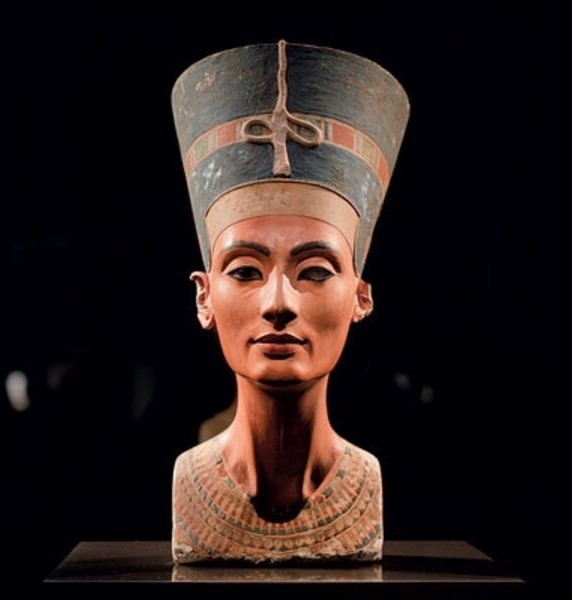
Egyptian, 14th century
Bust of Nefertiti – 1340 BC
Collection of the Egyptian Museum of Berlin
The Bust of Queen Nefertiti was discovered in 1912 by German archaeologist, Ludwig Borchardt. This limestone, painted stucco, quartz, and wax sculpture is from Ancient Egypt, specifically around 1340 BC, created by Thutmose who is thought to be the official court sculptor of the time. He served Ahkenaton, who created a period of great religious, political, and artistic change within Ancient Egypt. By his side, powerfully ruling as almost his equal, was Nefertiti. Her likeness has become well known as a symbol of international beauty. Her symmetrical and delicate features exude elegance and maturity, even though she has apparent “flaws” like lines under her eyes and around her mouth. This sculpture works to reflect the diversity of age and gender within our utopia and with this diversity comes happiness and fulfillment that comes from being surrounded by people of different genders and ages. Women can be leaders; age is not seen as something that hinders people. Anyone can participate and engage with the community.
