Lauren Frank
American, 1900 – 1992
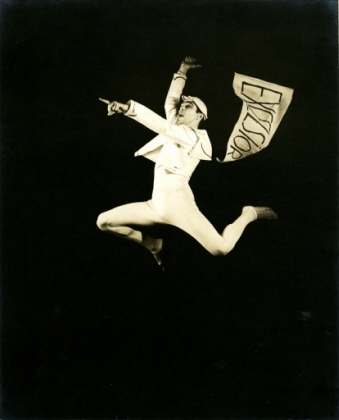
Charles Weidman – Race of Life, 1930s
Collection of the Haggerty Museum of Art, Marquette University
This image was photographed in 1938 by Barbara Morgan, an American photographer who lived from July 8, 1900 until August 17, 1992, and whose main medium of art was photography. She was impacted heavily by the Great Depression in her life, and while she began as a painter, then transitioned to being a photographer, the last two decades of her career were spent in the medium of photomontage. The artistic movement that she was a part of was the American Modern Dance Movement. The Race of Life was made a couple years after Morgan arrived in New York, when she abandoned painting, and instead adopted photography as a medium. This piece, entitled ‘Charles Weidman – The Race of Life’, is a photograph in gelatin-silver print. Gelatin silver prints are manufactured by adding emulsions of light-sensitive salts in gelatin to a sheet of paper coated in a white pigment. This photograph has somber colors but the vibe seems more happy or more opportunistic. There is a banner that is included in this photograph that says Excelsior, the New York state’s motto, which means Ever Upwards. This piece speaks to our groups idea of how the idea of what leads to happiness throughout different utopias. From what I know of this time, the 1930s Great Depression, I can understand that people were constantly doing so much to get by. Mental health was a misunderstood concept in this time and being constantly overworked and pushed to the brim, people sometimes had dealt with just too much. Everyone at this time was constantly racing to achieve the always changing “American dream”, but few were actually able to achieve it, almost like trying to achieve happiness in a utopia or dystopia. Everyone was trying to succeed in life and to feel fulfillment in their life, but it was a challenging time to do so.
French, 1871 – 1958
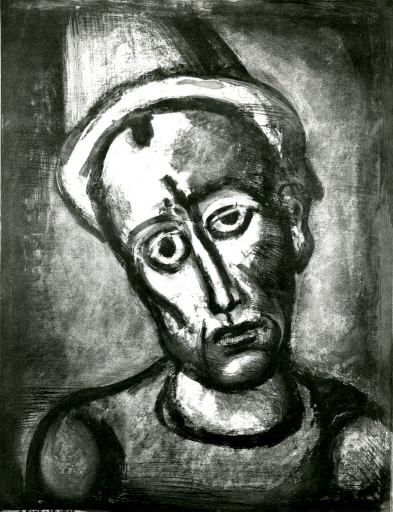
Qui ne se grime pas? (Who does not wear a mask?) – 1948
Collection of the Haggerty Museum of Art, Marquette University
This image was created by Georges Rouault (1871-1958), a French painter who was a member of both the Fauvism and Expressionist movements. Rouault was born in a Parisian cellar after his family’s home was destroyed in the Paris insurrection of 1871. Rouault was appointed as the Curator of the Moreau Museum in 1898, after the death of his beloved mentor Gustave Moreau in 1897, and soon fell into a deep depression that saw him ceasing to paint for a while. Following Moreau’s death, his attention was diverted to displaying human misery. After a long battle trying to have 700 paintings returned to him, he won, and had those pieces returned. This return of his property sparked warmer colors into his paintings, and completely changed his vibe of painting. ‘Qui ne se grime pas’ was an engraving on paper made in 1948, this piece belonged to the German Expressionism movement that, while Rouault partook in, was not actively associated with. This engraving was a dark, moody, and mysteriously colored piece, it channeled a very somber and depressed mood into the viewer of the piece. This image, a clown looking very downcast, was done during a period of deep depression for Rouault. He enjoyed painting those considered outcasts: clowns, acrobats, jugglers, as well as prostitutes. He painted them in order to show the true misery and unhappiness felt by humans. The main theme being somber and asking who is able to constantly show their true happy feelings all the time without putting on a mask. This relates to my group by talking about the false appearance of happiness in utopias, most putting on masks or disguising true feelings. Most utopias highlight the idea of uniformity, as well as having no freedom of expression, this would easily lead to unhappiness as most have no ability to express themselves in the way they wish to.
American, 1933-2017
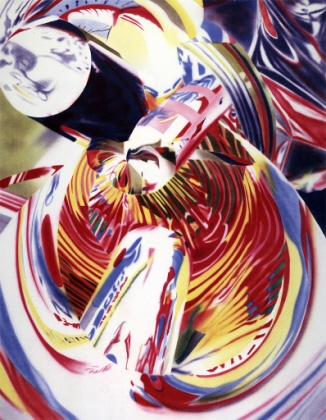
Navigator – Speed of Light – (1999)
Collection of the Haggerty Museum of Art, Marquette University
American, 1933-2017
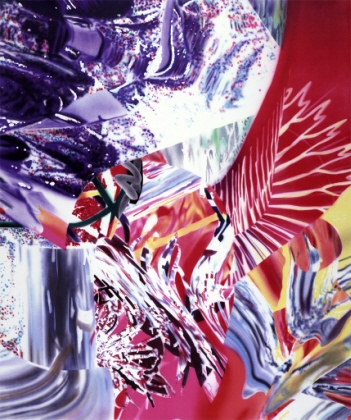
Pilot – Speed of Light – (1999)
Collection of the Haggerty Museum of Art, Marquette University
James Rosenquist information:
James Rosenquist, an American abstract artist, was born on November 29 in 1933 in Grand Forks, North Dakota. Before he went on to create colossal masterpieces in numerous states, and a couple countries, he was known for his commercial sign paintings on massive billboards. His career in commercial art started when he was eighteen, after he was pushed to pursue a summer painting job by his mother. On April 25, 2009, a massive fire swept through the house that Rosenquist had been living in for 30 years, this fire destroyed all of the paintings that had been stored there. He began by painting Phillips 66 signs, painting at gas stations from North Dakota to Wisconsin. He applied his skill from painting billboards to begin creating large-scale paintings, and thus his involvement in the pop art movement was begun. He emerged around the time that Andy Warhold and Roy Lichtenstein did, and was grouped into the category of pop art, even though his pieces were more unique with the various elements they included. He tended to include elements of surrealism, while also using parts of advertisements and societal imagery in order to emphasize the overwhelming sense that advertisements produce.
Piece 3: Navigator – Speed of Light
This painting, made in 1999 by James Rosenquist, was a chaotic, creative masterpiece. The colors are bright and pop very well against the white background in order to put more emphasis behind the organized chaos created by Rosenquist. It is related to the pop art movement, while also channeling the idea that advertisements can be overwhelming in nature. Honestly, I see little organization in this piece, as well as in its counterpart, ‘Pilot – Speed of Light’, the atmosphere of these pieces is chaotic and disorganized and I believe that is the idea of these abstract pieces. In order to show the disorganization and overwhelming nature of advertisements and daily life as a whole, these pieces were made chaotically. I imagine this piece as relating to our theme in the sense that in utopias, typically the ruling class or government plans life out exactly. When life is planned out in this way, then the government is just waiting for the inhabitants of this utopia to follow directly these already decided life moments. There are two types of governments in utopias, the ones that control every single aspect of life, and the ones that do not, and have a little bit more freedom in the whirlwind thing that is life.
Piece 4: Pilot – Speed of Light
This painting, also made in 1999 and also paired to the previous piece, is also a chaotic, overwhelming masterpiece. The colors are bold, bright, and colorful, while the mood is chaotic and playful, almost whirlwind seeming. It does not have much organization either, following along with what went on with the other piece in the set. Similarly to the previous piece, I believe this piece fits with the group theme because while the other piece focused on the way that government controls every aspect in certain utopias, this piece focuses more on the individuality that is exhibited in the occasional utopia. Being entitled, ‘Pilot – Speed of Light’, I imagine a person being able to pilot themselves through life, having the ability to lead their own life free of immensely rigorous schedules. With more freedom, people will be more happy and while they may still feel controlled, it will allow for more freedom to life and expression of themselves. All in all, while this piece I believe seems to allow for more freedom in life to choose your path, I do believe the previous piece more shows what a controlling utopian government will be like.
