Ryan Kim
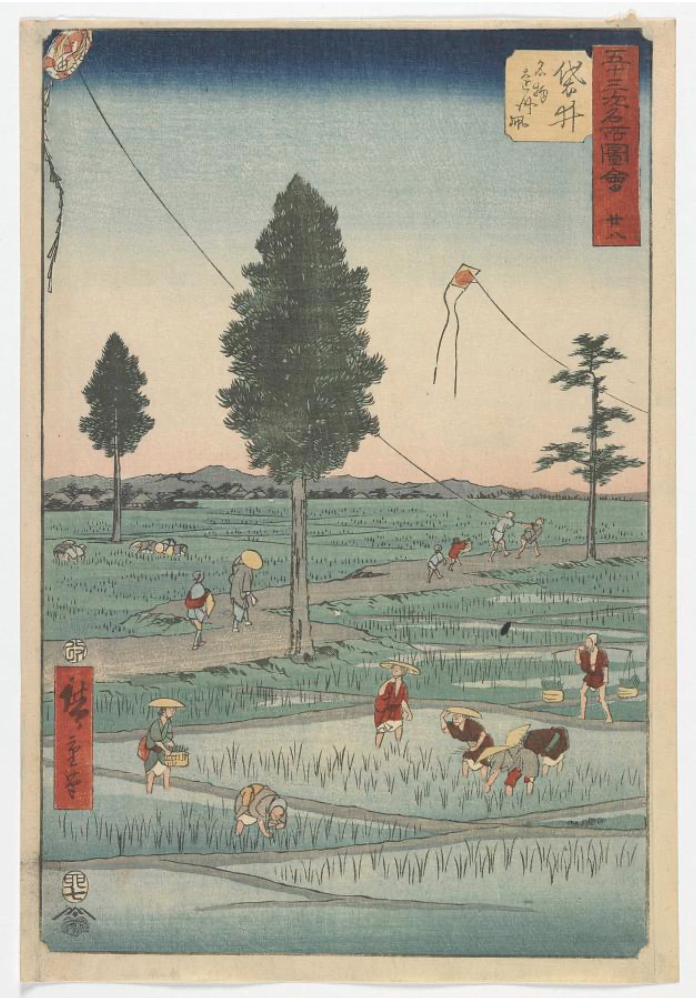
Japanese, 1797 – 1858
Untitled – Date unknown
Arthur M. Sackler Gallery, National Museum of Asian Art
This image was created by Utagawa Hiroshige (1797-1858). Hiroshige is widely regarded as one of the last masters of ukiyo-e woodblock printing, a traditional Japanese woodblock printing technique that was popularized during the Edo period of Japan. The Edo Period of Japan was regarded as a time of peace and stability, which allowed for the arts to flourish. Hiroshige was born to a family of samurai, living in the area that would now become known as Tokyo. He lived through the death of his sister, mother, and father by the time he turned twelve. Despite the death of his family, due to his family’s high ranking in society, Hiroshige was able to find work as a firefighter, while pursuing art. Initially, he produced images of kabuki figures, or images of “beautiful women”. However, he would eventually turn his focus to images of landscapes, which would bring him to notoriety. Little is known about this specific work by Hiroshige, specifically the title and exact date that it was created. However, this is one of Hiroshige’s works utilizing the ukiyo-e woodblock printing technique, his most well-known medium of art. The image depicts a rice paddy, and numerous individuals working the fields, but also the depiction of children with kites running along the road next to the rice paddy. Within a society, farming/food production is crucial. This allows the society to survive and eventually develop once sufficient food production is established. The inclusion of the children with kites also shows that farming/food production is essential for the future of any society, as it is the backbone of any successful society. Individuals choosing to enter farming would find joy/fulfillment in helping the society through means of helping the society survive, even if it is one of the more rudimentary professions.
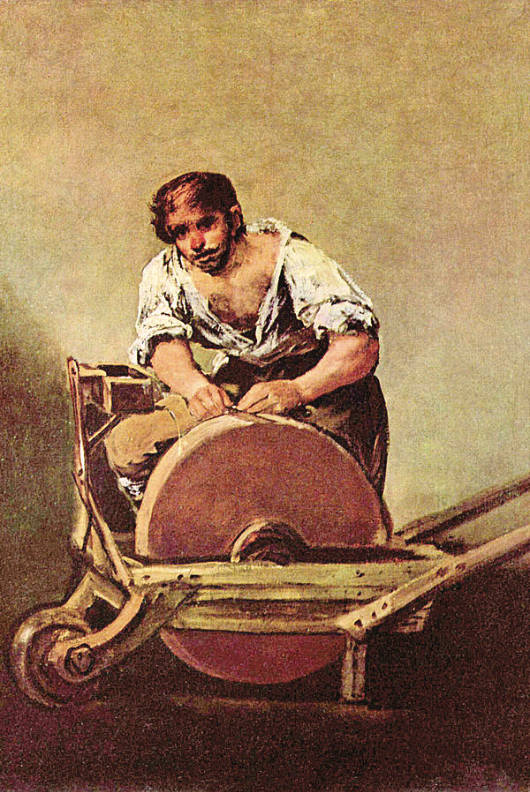
Spanish, 1746 – 1828
The Grinder -1812
Old Master Paintings, Museum of Fine Arts, Budapest
This image was created by Fransisco Goya (1746 – 1828). Goya was regarded as one of the most important/influential Spanish artists of his time. Goya began art at the age of fourteen, entering art competitions that he was initially unsuccessful in. However, by 1778, he had gained influence and notoriety for his artworks, entering the royal collection and in 1786, was the painter of the king, King Charles III. The rule of King Charles III and IV (1759 – 1808) was considered the enlightenment era of Spain, which heavily influenced Goya’s art. However, this era was ended by Napoleon’s invasion of Spain in 1808, which caused the death of many and the end of the era. This also influenced Goya’s art, who published art under the series The Disasters of War, which depicted Spain’s struggle to gain independence after the invasion of Napoleon. The Grinder is an oil-canvas painting created in 1812, after Napoleon’s invasion of Spain. Goya named the painting in a straightforward manner, naming it exactly what is depicted. Within a society, the presence of specialized professions shows the success/development of the society. Within a Utopia, the presence of such professions would allow for the wants/desires of the Utopia to be fulfilled, producing goods and providing services that would benefit the society past its needs. The implementation of such professions would directly improve the happiness of the society, providing goods and services people seek and providing professions for those to enter who enjoy them.
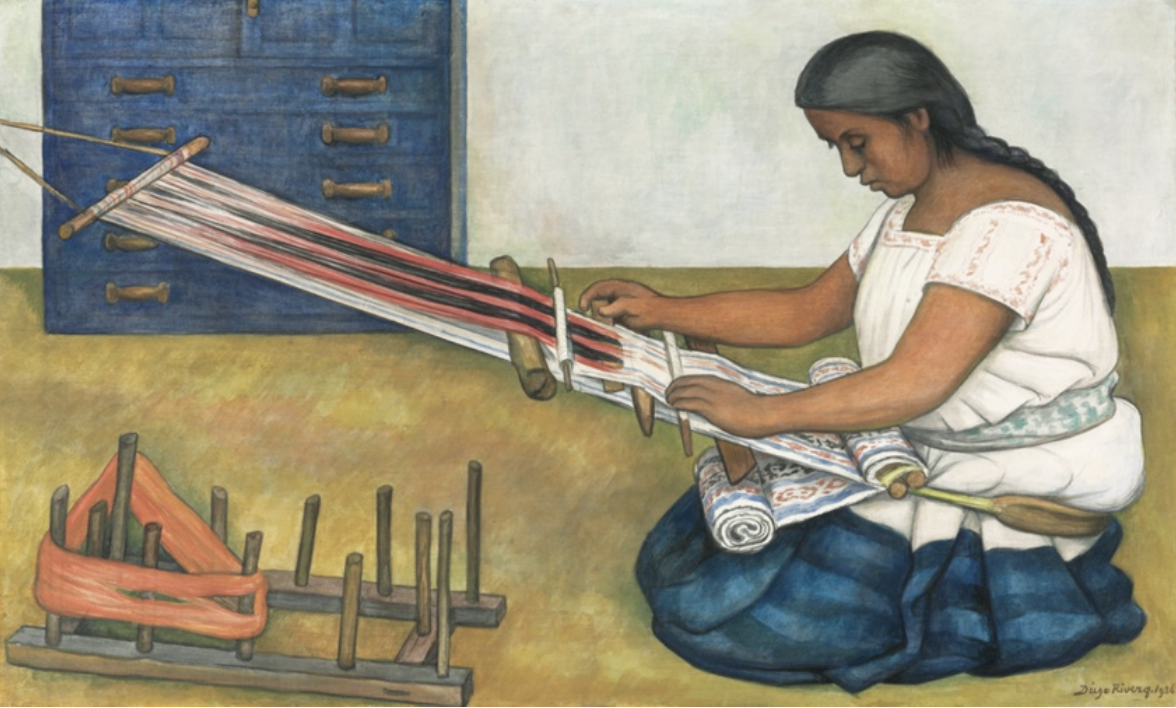
Mexican, 1886 – 1957
Weaving – 1936
Art of the Americas, The Art Institute of Chicago
This image was created by Diego Rivera (1886 – 1957). Rivera is regarded as one of the most popular artists of his time. Rivera began his art career training in Mexico City, and then traveled to Europe and became one of the leading figures in the arts. In his early days, he was known for using an art style known as Cubism, which was popular among other famous artists such as Picasso. However, there was a shift in his artwork in 1917, with major political events such as the Mexican Revolution. His artwork shifted towards images of the working class, with influences from his Mexican heritage. His images depict individuals along with their stories, ranging from miners, farmers, and other working-class professions. Weaving was an oil-canvas painting created in 1936, and depicts the life of Luz Jiménez, a weaver. Jiménez used a traditional form of weaving, which particularly fits with Rivera’s interest in incorporating his Mexican heritage into his artwork. Within the artwork, Jiménez takes up a majority of the right side of the image, with the left side of the image being occupied by the different tools/materials necessary for weaving. Much like the prior image, the existence of specialized professions shows the success/development of the society. In addition to being a crucial part of society, clothes making is an art form, allowing the individuals entering the profession to both express themselves and those who wear their goods. This self-expression and joy brought from clothes-making, along with many other professions provide ample reasoning for the importance of work within a Utopia.
